
Your Book Is a Car
Where I unleash corny metaphors...

My father knew how to take apart an entire motor vehicle. I think he might have enjoyed dismantling a 747 since he loved planes, boats, and cars and used them as often as possible. It’s been told that he could remove and rebuild an engine, displaying the bones all over the driveway. Time lost all meaning as he sorted through wires, bolts, axles, joints, every body part you can imagine.

He taught me a few things about cars, how to change the oil, coast down a mountain without gas, check tire pressure, downshift to slow down, and operate a standard. While he was too micro-managing as my driving instructor, he instilled in me a basic principle while facing situations that seem impossible to solve: Take the whole thing apart and don’t rush.
In the excitement of creating a story, I often follow my instincts and go too fast. In so doing, I finish with a less than viable product. The main characters make me fall asleep at the wheel. It’s obvious I don’t care enough. The anti-climactic moment lacks fuel. The premise, overdone.
So I take it apart, down to nothing. Sometimes, I leave the parts on the driveway for years. You know what that’s like.
I’m lucky to be inspired by writers as skilled with prose as my dad was with cars. Most recently, a wildly talented author showed me the depths to which she tabulates every breath of her characters’ lives and what propels them to the next pitstop. I enjoyed listening to how she detailed every “why,” her precise vision. With my own experience as a troubleshooter, I can riff and build on and off ramps, pick out the one element that keeps the writer from (you think I’m going to say “landing the plane” but that’s going overboard) “parallel parking in a New York City car space just perfectly.”

Writing and editing make for a beautiful friendship. Collaborating with another person (human) in this way can be quite useful if you’re looking to fix your novel. But you have to be willing to listen to your editor’s ideas and know what you don’t know. Which often comes from ripping everything to shreds and putting it back together.
If you’re a solitary practitioner writer like me, you can demolish your own story and rebuild. Ask yourself…
What don’t I love about this story? Be honest. Very honest. Then be more honest.
What parts don’t quite fit? (maybe the ones you love most)
What made me think of this story in the first place? The imposter syndrome, reunion, rags to riches theme, that picture that I can’t get out of my head?
Are these characters as adorable as ______ and _______? Here’s where I make a list of those fictional people I love so much. Some I will take a bullet for, others meh. Go with the idea of being a human shield.
Is the story too complicated or not complicated enough? Thriller writers do a great job of mastering the “too complicated” and sometimes that’s the way to go. But if you’re a kitchen sink type of writer, your goal may be to simplify and add power to one central theme.

Will my voice hold the reader’s attention? That’s always the thing, no matter what your story is about, the #1 reason for the thousands of rejection letters I sent.
Does the book take the reader where it needs to go? This is when I consider Wile E. Coyote and how he didn’t care about going over the cliff. His id had no stop sign and he needed to catch that dynamite before it went off in the wrong place. But then he realized he was now carrying the dynamite and it would detonate. I often feel that the last third of a book should be like Wile E. Coyote racing to his many demises.
Last but important question: How is this tale saleable, marketable, flashy? I know, demoralizing to see this as crucial, but it is, at least in traditional publishing. At the same time, numerous stories did not start out as “saleable” but brought a reader/viewer into an exciting new world. As a writer publishing their work in the hope of gaining traction, the big fame and money, the flashiness must play a role.
But kudos to those of us who drive in the right lane, have our route locked in, sometimes go under the speed limit (I’m not naming names), and most recently were told they shouldn’t drive at night. We just do our best at our own speed, analyzing and revising what future readers will no doubt buy above sticker price.
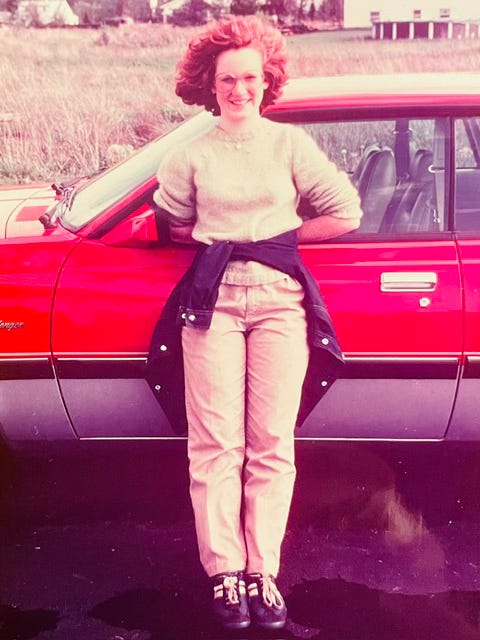
Here I am being very 1981 at my grandparents’ house in Watertown, Connecticut via my dad’s car.
Very nice Patience!
An entertaining read, as always, and these are terrific questions. I hope you don't mind if I share this in A Writing Room, the robust online community affiliated with Anne Lamott. I lead some writing groups there...this could be fodder for plenty of discussions. And (sigh) if I ever get back to my own writing, I know these questions will help. Thanks!